Since becoming Brigham Young University president on May 1, 2023, President C. Shane Reese has spoken frequently to students, faculty and staff, donors, and the entire BYU community. For his September 19, 2023, inauguration he selected the theme Becoming BYU. The following compilation highlights several of his key messages from the past seven months and 10 of the invitations he has extended.
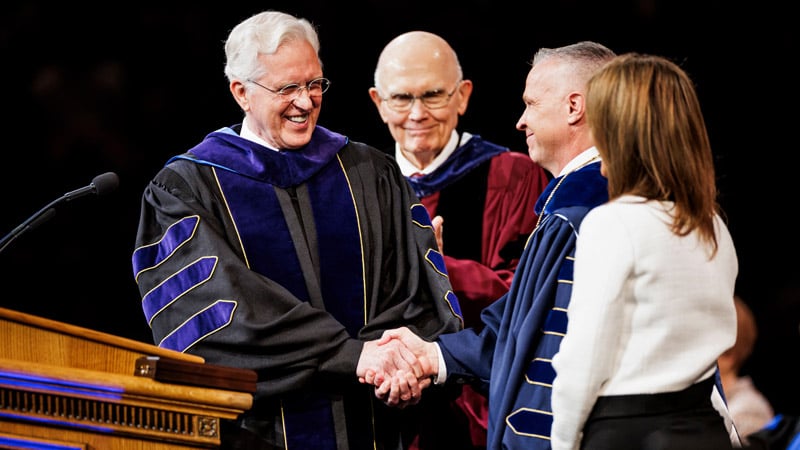
Elder D. Todd Christofferson gave the inaugural charge and was joined by President Dallin H. Oaks in the installation of C. Shane Reese as the 14th president of BYU on September 19, 2023. Elder Christofferson said, “As we worked with the First Presidency in this process [of selecting a new president], I can attest that all of us felt guided to Shane Reese as the person for this moment and time.”
Become a Unique University
We each play an important role in the BYU community. As disciples of Jesus Christ and members of the BYU community, we must be committed to fostering a culture of unity, love, and belonging. We must seek for and be led by the Holy Ghost—not just in religious education classes, not just in family life classes, but even in statistics classes, research labs, and work- spaces. Everywhere on campus we want students, faculty, and staff who are “press[ing] forward, feasting upon the word of Christ” (2 Nephi 31:20). To this end, we seek to hire and support BYU employees who intentionally build faith in Jesus Christ and desire to strengthen their own and others’ testimonies of the restored gospel.
If we are to be successful in fulfilling BYU’s mission, we must be unique, we must differentiate BYU, and we must embrace our mission— especially the spiritual development of our stu- dents. As we enlarge our influence and move toward fulfilling our mission, BYU will become the university of the Lord that President Spencer Kimball so beautifully foretold in his second century address.
1. I invite you to study President Kimball’s address carefully and prayerfully. In it, he out- lines a path for BYU’s future that will strengthen us as we embrace our uniqueness. In 2025 we will reach the halfway point of our second century as a university. Although we have made important progress, much remains undone, and you can play a critical role in helping us to realize President Kimball’s incredible vision.
BYU is a unique university and must remain so. The lives of students are changed at BYU. I have seen greater understanding and application of the gospel in the lives of our faculty, staff, and donors, and in my own life because of BYU.
The mission of BYU is to assist individuals in their quest for perfection and eternal life, and we are those individuals.
Seek God’s Direction
I offer three specific suggestions for how we might invite God’s direction into our lives more fully:
2. Recognize the Lord’s timing. As President Dallin H. Oaks suggested, doing the right thing at the right time is the most important thing. We will be patient with the Lord’s timing and gain a greater sense of His design in our lives as we understand His timing.
3. Look up—both upward to God and up from your phone. Note that many on this campus are feeling a sense of loneliness. Some merely need a smile from you and from me. We can only see that need and see those smiles as we look up!
4. Cultivate a sense of gratitude. This must be a deliberate and intentional act to recognize God’s hand in your life. We are better at acknowledging His hand when we are looking for things to be grateful for—and when we readily express gratitude to God and to others.
I reiterate what Elder David A. Bednar shared on this campus in April 2021: “There is no such thing as a coincidence in the work of the Lord.” Each of us is a beloved child of heavenly parents with a divine destiny.
“As we embrace our unique institutional identity, we will foster at BYU a unique learning environment that will empower us to be peacemakers in an ever more divisive society.” —President C. Shane Reese
Introspection and Progress
Becoming BYU will require personal introspection. Fulfilling this challenge cannot come solely from the university administration. It will require broad-based leadership from our entire campus community. It will require each of us to regularly assess our progress. In that spirit, let us ask ourselves these three questions:
5. Is the mission of BYU changing me or am I trying to change the mission of BYU?
6. How can I use “gospel methodology, concepts, and insights” in my daily life to more readily receive inspiration, become a lifelong learner, and increase my capacity to assist others?
7. Do I have the humility to ask what I need to change and the meekness to ask, “What lack I yet?”
Gratitude For You
In recent years you have generously contributed to provide inspiring learning experiences for tens of thousands of students. You have made an enormous difference in their lives and for BYU.
BYU is an undergraduate teaching university with graduate programs of consequence. Scholarly research and creative endeavor by faculty and students are essential and will continue to be encouraged, and we are striving for every student to have at least one inspiring learning experience during their time here.
Thank you for your willingness to help BYU fulfill its mission. We appreciate and need your help. Will you consider the following invitations?
8. Help us tell our unique story. We have an amazing university with a unique and audacious mission—we need your help to tell the BYU story.
9. Let your light shine. The BYU story will be told better by those who share the unique light of BYU in their personal lives than by the messages published by the media.
Give back or pay it forward. This is not only a financial invitation; I am asking you to lend your light to those around you and help them see the goodness that BYU brings to the world. You can help them see God’s love in their lives, and you can use your light to point people to Jesus Christ.
As we do these things, I believe that we will be blessed both individually and institutionally, coming closer to what God wants us to be personally and to what He needs BYU to be. This is what I mean when I talk about Becoming BYU.
I close with the testimony of President Dallin H. Oaks, who declared:
[I] firmly believe that it is the destiny of Brigham Young University to become what . . . prophetic statements predicted it would become. But inherent in being the university of The Church of Jesus Christ of Latter-day Saints is the reality that this great goal will not be attained in exactly the same way that other universities have achieved their greatness. With your help, [BYU] will become the great university of the Lord—not in the world’s way but in the Lord’s way.
Read or watchPresident Reese’s “No Coincidences” and “Becoming BYU: An Inaugural Response” and President Kimball’s “The Second Century of Brigham Young University” at speeches.byu.edu.